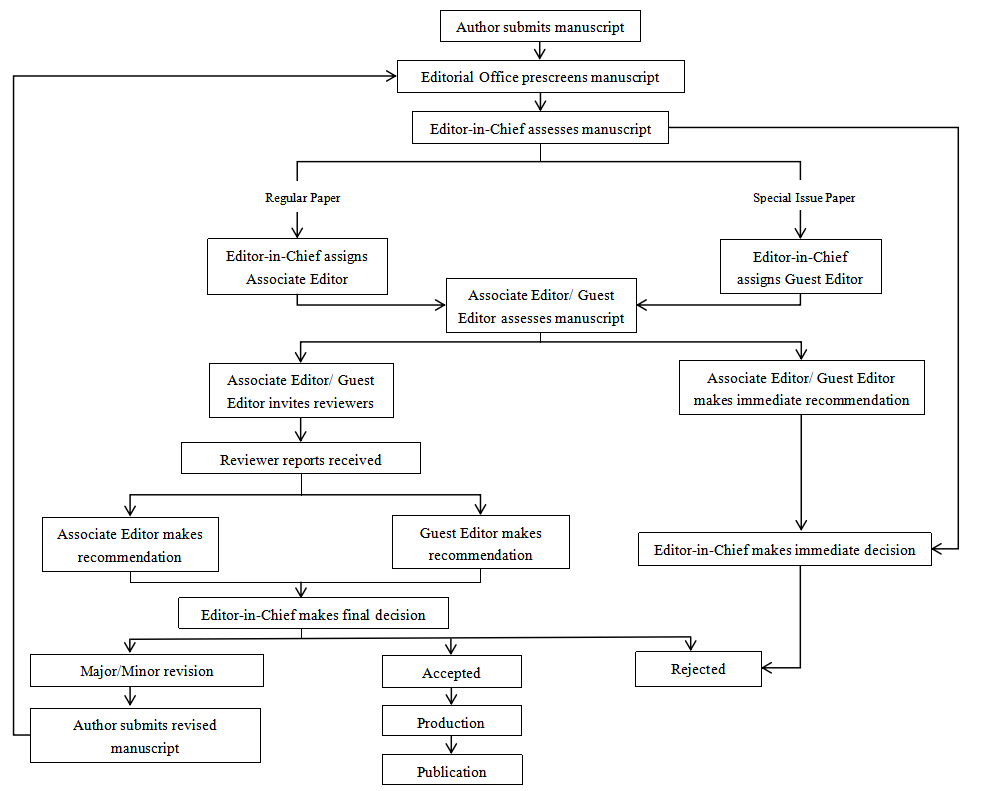
The final structural decision on whether a submission is accepted for publication is made exclusively by the Editor-in-Chief. This is strictly applicable to all submissions, including those processed under targeted Special Issues tracks.
1
Once the author submits a manuscript for review, it will be prescreened by the Editorial Office. The staff will check whether it meets our technical requirements for submission. The Peer-Review Support Specialist will check whether it is in accordance with the journal's aims and scope.
2
Following completion of the prescreen by the Editorial Office, the manuscript will be assessed by the Editor-in-Chief. A comprehensive evaluation will ensue, considering alignment with the journal's aims and scope, methodological rigor, and overall article readability. The Editor-in-Chief may make an immediate decision on the paper at this stage.
3
Subsequently, the Editor-in-Chief will assign the manuscript to an Associate Editor or Guest Editor (for submissions to Special Issues) based on the research fields encapsulated.
4
Upon receiving the manuscript from the Editor-in-Chief, the Associate Editor or Guest Editor will assess the manuscript for its suitability for peer review. The Editor-in-Chief may make an immediate decision to reject based on the Associate Editor or Guest Editor's recommendation at this stage.
5
The appointed Associate Editor or Guest Editor will then meticulously invite a minimum of two anonymous reviewers for the manuscript, adhering to the double-blind peer review approach, which means the reviewers do not know the names of the authors and the authors do not know who reviewed their manuscript (but if the research is published, reviewers can eventually know the names of the authors). All reviewers are external experts.
6
The Associate Editor or Guest Editor will make a recommendation after receiving reports from at least two reviewers. If the reviews differ widely, the Associate Editor or Guest Editor may invite an additional reviewer so as to get an extra opinion before making a recommendation.
7
Subsequently, the Editor-in-Chief will make a final decision based on the received recommendation and his/her own assessment of the manuscript, indicating approval for rejection, acceptance, minor revision, or major revision.
8
If the article is rejected or sent back for either a major or minor revision, the corresponding author(s) will receive the reviewers' comments. A final check by the Editor-in-Chief is a must before sending acceptance to any revised paper. Once your paper has been accepted, it will be checked by the editorial office to ensure that it is ready for production. If any updates are necessary, you may be contacted. Otherwise, your paper will be forwarded to the production team.
9
When the production team receives the accepted article, the corresponding author will be contacted by email to ask them to sign a publication license and pay Article Processing Charges.
10
The corresponding author will receive an email for approval before it is typeset. Authors should check their proofs carefully to confirm all the information is accurate. Proofs must be returned within 5 working days of receiving the email.
Reuse of words must be kept to a minimum, credited, or quoted in the text, and all sources must be cited when they are used. The Journal of Computational and Cognitive Engineering uses the Similarity Check service provided by Crossref and powered by iThenticate to provide editors with a user-friendly tool to help detect plagiarism.
A text similarity index score below 20% is acceptable by the journal editorial guidelines.
The CrossRef Similarity Check uses iThenticate originality detection software to identify text similarities that may indicate plagiarism. It does this systematically by comparing manuscripts against both an extensive world-web repository and the CrossRef historical metadata database.